The technology
Precision without overstatement.
The tool creates a stimulus. The person remains the centre of the experience.
See the current toolkitA useful boundary
Controlled input.
Open human response.
Technology can define timing, intensity, duration, and the sensory channels used. It can sometimes support measurement under specified conditions.
It cannot guarantee relaxation, insight, sleep, focus, healing, or any other named state. Vedazon uses tools to support an experience, not to turn a person into a protocol.
Output / measurement / experience
The three layers of truth.
What is delivered, what is measured, and what is experienced must not be collapsed into one claim.
01
The device delivers
Timed visible light, sound, or vibration at a chosen intensity and duration. This is the controlled input.
02
Researchers measure
Signals such as stimulus-linked electrical activity, timing, physiology, or reported response under defined conditions.
03
A person experiences
Colour, pattern, rest, alertness, emotion, imagery, or little at all. No response is guaranteed or required.
The current toolkit
Quietly present.
Clearly named.
We name the tools you may encounter, what each contributes, and where its limits begin—so you know what to expect.
01
ROXiva RX1
Current on-site tool
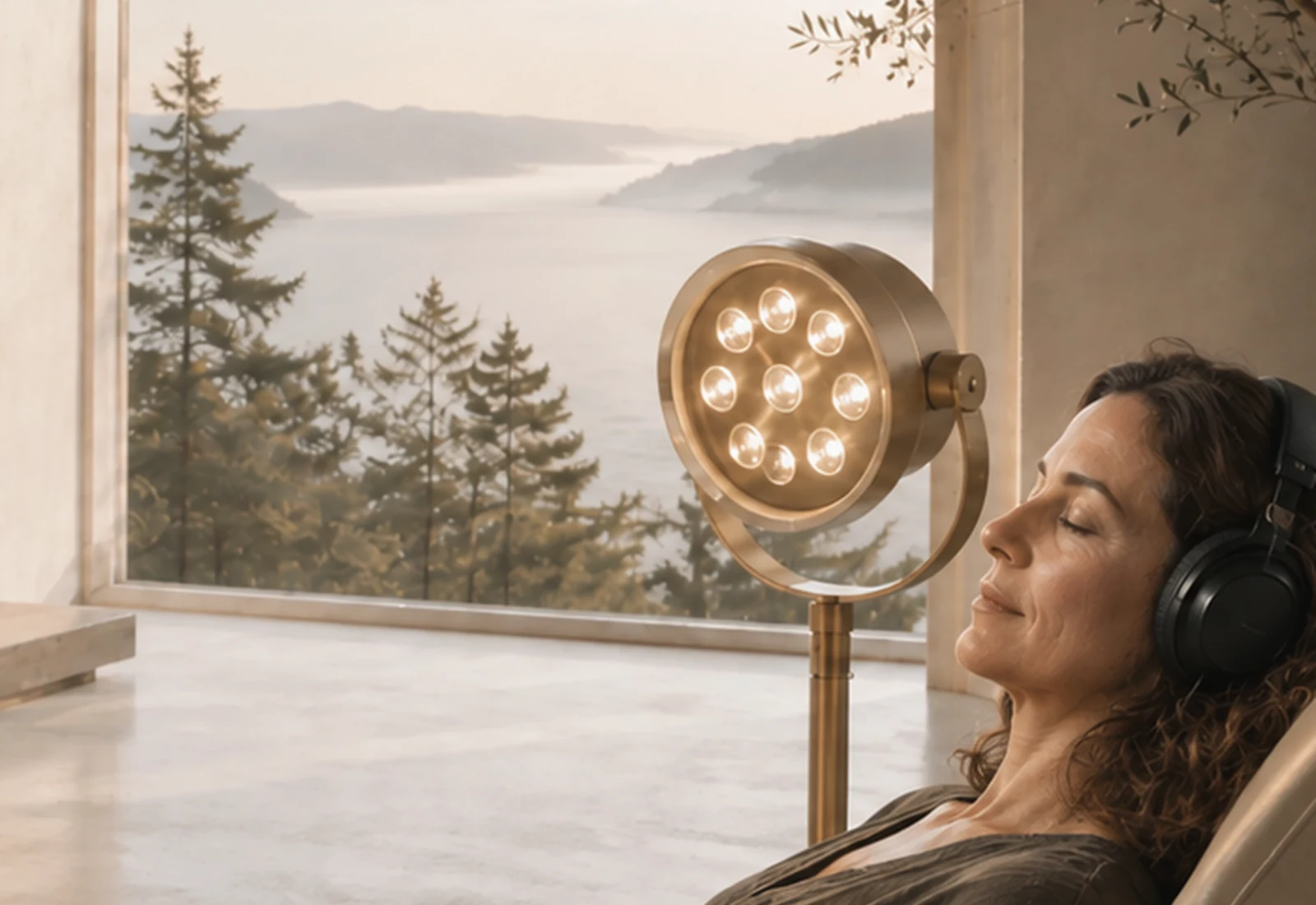
Visible pulsed light through closed eyelids, coordinated with sound. NeuroVeda is the experience; ROXiva is one tool within it.
02
Sound + headphones
Current experience channel
Audio, rhythm, voice, or quiet may support pacing and context. Sound does not guarantee a named brain state.
03
Haptic vibration
Where offered
Woojer may add synchronized vibration in selected experiences. It remains a sensory input, not a treatment claim.
04
Compatible home tools
Client-owned options
NeuroVIZR or Woojer may support remote planning for clients who already own a compatible device.
05
EEG + observation
Measurement context
Measurement tools are distinct from NeuroVeda and are not presented as diagnosis, treatment, or proof of a promised outcome.
Different fields / different methods
Similar words can describe very different things.
These methods can sound similar but work differently. Knowing the distinction helps you understand what is being offered.
Sensory stimulation
Current Vedazon practice
Repeated visible light, sound, or vibration presented as a sensory input. A stimulus can influence response without reliably producing a named state.
Neurofeedback
Distinct measurement method
A measured signal is returned as feedback. It is not the same as rhythmic light and sound, and it is not implied in every NeuroVeda experience.
Photobiomodulation
Not NeuroVeda
Specified red or near-infrared wavelengths delivered at defined doses to tissue. NeuroVeda does not make mitochondrial, cellular, or tissue-healing claims.
A case study in careful language
40 Hz: measurable interest, not a promised result.
Research near 40 Hz has shown that sensory stimulation can evoke gamma-frequency neural responses. Small human feasibility studies have also explored repeated stimulation in clinical populations.
Clinical benefits, optimal parameters, long-term effects, and individual suitability remain under investigation. Vedazon does not offer 40 Hz stimulation as treatment for a neurological condition.
Explore the evidence on our Science page. A measurable response does not guarantee a particular personal result.
A better technology question
Ask what is delivered, measured, and claimed.
01
What exactly does the device deliver?
02
What is measured—and what is only reported?
03
Is the evidence for this device, this parameter, and this use?
04
What remains uncertain or individual?
05
What screening, support, and stop controls are in place?
Scope
Vedazon offers educational guidance and wellness experiences. We do not diagnose, treat, cure, or prevent medical or mental-health conditions, and our work is not a substitute for licensed care. Pulsed light does not suit everyone — if you have any history of epilepsy, seizures, or sensitivity to flashing light, read the screening list before booking.